Author Archives: Josie Whiteley

About Josie Whiteley

JAWCommunication offers a number of services including: Writing (copy, features, reports, press releases, speeches) editing, proof-reading & Social Media. JAWCommunication is run by Josie Whiteley who has worked as a Sub-Editor, News Reporter, Writer, Lecturer, External Examiner, Standards Verifier and College Manager over her 30+-year career. Please contact Josie if you need help to finalise your own written work: • Proof-reading, re-writing and editing services available. Or if you need help with any of the following: • Copy-writing, feature-writing, reviews, report-writing, newsletters, press releases, speech-writing, academic writing and Social Media. As an experienced College Manager Josie also works with Colleges in a consultancy capacity. Contact JAWCommunication@mail.com for further details. Twitter: @JAWCommunicate

WHOLE CARE Code of Leadership success

I am proud and feel honoured to have been trusted to represent Leaders and Managers in the National Education Union during this last year having been elected President of the Association of Managers in Education.

My final blog as AMiE President can be read below.

I’m pictured at the launch of our WHOLE CARE Code of Leadership Practice with AMiE Director Mark Wright and Joint General Secretary of the NEU Dr Mary Bousted.

Leaders must keep fighting, says outgoing AMiE President Josie Whiteley (as published on AMiE website Aug 31st, 2018)

As my year as AMiE President comes to an end I have been looking back over the last 12 months wondering if I have made a difference.

It has been a significant year for me, in that it has cemented my view that we must all be prepared to speak truth to power as and when needed.

And I have worked hard to do that whenever I could.

I’ve had the chance to speak out at conferences about the need for ethical leadership, the decimation of the Arts and narrowing of the curriculum, constant curriculum changes without any discussion with experts, forced GCSE resits in the post-16 sector, T-Levels, DBS checks destroying lives, health and the need to focus on the wellbeing of staff and students. The list goes on.

I have felt privileged to have had that opportunity to speak out, often for those who dare not because their working environment is toxic and they fear the repercussions.

I have come across some influential leaders over the last 12 months, some who absolutely “get it” and some who don’t. I think it is fair to say that if you are leading an academy or a college and being paid £200k+ a year then you need to take a long hard look at what you are doing and why.

Most people involved in schools, colleges and universities are drawn to the role because they want to contribute to society through educating others. They should be properly rewarded for their work and of course there will be a salary scale dependent on roles, but there also has to be some realism and some fairness in the pay scales.

Meanwhile, the Government thinks education “on the cheap” is acceptable in one of the richest countries in the world. An part-funded teachers’ payrise is useless when many schools are facing a funding crisis. An effective 25% cut in pay for FE staff over the last decade is a disgrace. This is what we are facing and leaders must use their influence to challenge.

I’ve enjoyed working with AMiE’s Director Mark Wright this year and the development of our “WHOLE CARE” Code of Leadership Practice is something I am proud to have been a part of. If I achieved nothing else I hope its publication this year will have an impact on those who have read it.

It is an easy-to-understand document. My personal expectation has been that all AMiE members should abide by that code and treat their colleagues with respect. There really is no excuse for behaving any other way.

A particular highlight this year was my visit to a primary school picket line where I distributed copies of the document and had a teaching assistant tell me it was one of the best things he had read. If everyone behaved in the way set out in the code, there would be no need for anyone to ever go on strike, he said.

Indeed!

The core of the document is about treating your team as you would wish to be treated. If lack of resources means you cannot do that and is forcing you into unethical behaviours then surely as a leader you need to take action? As we have seen in the School Cuts campaign mobilising governors, parents and students can make a real difference.

It has been heartening this year to see education leaders speaking out and fighting for the resources they need to teach those in their care and to pay their staff properly. Leaders lobbying Parliament and speaking out on social media really can instigate change.

Never forget, ethical leadership makes a difference every day and has a positive impact on everyone involved.

Finally,  I would like to say a big thank you to all the various staff teams I have worked with during my time as president, and also to the other ATL Section Officers who have had to put up with me for a whole year!

I wish AMiE’s next President Lesley Tipping the very best as she takes over.

T-Level Trauma

Another blog I wrote as AMiE President discusses T-Levels which seem to be flavour of the month in the world of FE.

You can read my thoughts below.

If you are involved in any way – as a lecturer, parent, student or industry expert – and T-Level development affects you feel free to share.

If it ain’t broke… (as published on AMiE website April 17th, 2018)

I’ve been pondering T-levels, the new “technical” equivalent to A-level that colleges will begin delivering in September 2019, and I’ve concluded that I have no idea why we need them.

What’s more, rather alarmingly, with just 18 months to go before the major reform of post-16 education begins, it’s clear colleagues in colleges know very little about this new qualification. We also have to ask if colleges – many of them struggling financially – will have the resources to deliver them.

The Government believes this new, level 3 qualification, which will be available in 15 pathways, will train people in the skills required by the UK workforce and those that employers, we are told, think students lack. But I’ve spent more than a decade working in industry and two decades working in further and higher education and I have no idea which skills employers think are missing.

If they want bespoke training then they should be offering it to their employees or perhaps making a financial contribution to their local college so they can deliver it. As far as solid vocational training goes, we already have BTEC diplomas. These well-known qualifications are essentially skills-based, including theoretical and practical units, although they do now have both course work and externally-marked exams. As a standards verifier for vocational qualifications, I’m not sure when BTEC became unfit for purpose and why we now need T-levels.

The Government’s proposals indicate there will be two pathways open to students aged 16-19: the academic option (A-levels) or the (T-levels) technical option. Initially, it said the applied general qualifications (most BTEC nationals fall into this category) would be part of the academic option alongside A-levels. However, the Government’s recent consultation document included proposals to review the continuation of existing 16-19 qualifications, including the applied general suite.

If T-levels replaced BTECs, we would see a narrowing of the curriculum for 16-year-olds because the new qualification covers fewer areas. Are we just going to lose these very specific qualifications? If I want to be a stage designer – is there a T-level for me?  Or should I take art, drama and English A-levels and find a drama course at university with a module including stage design?  Or will BTEC level 3 production arts, the qualification all my students have undertaken to study production arts at university before moving onto great jobs in the industry, still exist?

It isn’t clear.

Neither is it clear how colleges will secure the required work experience of 45-60 days for T-level students. Shorter work placements have already proved impossible for colleges over the last few years when work experience has been a requirement of funding. And ridiculous rules stipulated that paid work (done by many students) could not be counted… actual work could not be counted! This is beyond ridiculous.

If you live in Manchester and want to work in the fishing industry, how do you get that experience? How much will placements cost young people in travel and accommodation if they need to live away from home? Have safeguarding issues been considered for such long placements?

In the end, the purpose of education isn’t simply to provide skills to local industry. It is far more than that. By all means cut down on such a huge range of post-16 vocational qualifications, so the choice is less confusing, but leave young people with enough choice to ensure they can pick a course right for them.

It’s not my intention to be unduly negative about T-levels, but I am reminded of the 14-19 Diploma. Introduced in 2008, it was axed five years later. It failed for a number of reasons and one of them was that it wasn’t clear what problem the Diploma was solving. The adage if it ain’t broke don’t fix it seems entirely appropriate now.

We don’t need a major overhaul of post-16 education.

It just needs to be properly funded.

EfFEctive Education campaign

I have been uncharacteristically quiet recently which I shall blame on the hectic final few months as AMiE President!

Just so you don’t miss out though I thought I would share a blog you might not have seen.

Funding for Further Education is something I feel very strongly about so you can read about my meetings to discuss this with MPs Paula Sheriff and Barry Sheerman below

The visit was part of the National Education Union’s #EfFEctiveEducation campaign. #LoveFE.

EfFEctive Education (as published on AMiE website April 4th, 2018)

I recently spent an uplifting morning visiting two MPs to talk about one of my favourite topics – Further Education.

The visits to Huddersfield MP Barry Sheerman and Paula Sheriff, MP for Dewsbury were part of the National Education Union’s EfFEctive Education project, which aims to make all MPs aware of the vital importance of Colleges.

Barry and Paula were clearly very passionate about education. Barry has held a number of education-related positions in his 30-year career and was chair of the Parliamentary education and skills committee from 2001 to 2010. He remains committed to asking the difficult questions, such as holding the Government to account for its constant policy changes and funding decisions.

Paula’s public service background, with experience in the NHS and her role as a shadow health minister means she understands the importance of having proper funding to support both the education and also mental health of young people attending colleges.

Both listened to what we had to say about challenges facing the sector, and reassuringly, it was clear they know about FE, understand it and care about it.

Unfortunately, the same can’t be said of many MPs. Few studied at a college and many aren’t aware of their local college and the challenges it faces every day. And there are many. Funding has been cut every year for the last seven years – it wasn’t brilliant to begin with – there is a recruitment and retention crisis, and forced resits of maths and English GCSE (only a third of students pass) are consuming resources and contributing to behaviour problems with some learners.

When 62% of 16-18-year-olds attend a post-16 college, it is time that more MPs realised what is being risked by continually underfunding a sector that is supposedly going to solve the predicted skills gaps we will have post-Brexit.

The Government’s Industrial Strategy seems to assume that this will automatically happen in colleges yet they are being starved of the money and the resources to deliver. The funding cuts, mergers, area reviews, wholesale reform to apprenticeships, the introduction of T-Levels and so on all cause serious uncertainty and prevent proper strategic planning.

Many colleges are on the verge of financial collapse.

Kirklees College, which has campuses in both MPs’ constituencies, was recently graded Good but is now consulting on proposals to restructure because of funding problems. Jobs may be at risk. When there is not enough money to go around, something has to give. Usually that something is staff, which has a direct impact on students.

The local sixth-forms Greenhead College and New College are graded outstanding,  but are also impacted by funding constraints. NUT-section member Sue Zadock, who works at New College, was also at our meeting and spoke passionately about the difficulties they are facing every day to deliver high-quality teaching. She was particularly unhappy about workload and the accountability drivers taking the focus away from students.

Why on earth would any Government that claims to value education, training and skills – and views Ofsted grades as important – force those establishments into a position where they are unable to continue their excellent work?

Barry and Paula agreed to ask some questions in Parliament on the issues we raised with them, which is great. In addition, Barry said he would push for a debate about sixth-form colleges in the House of Commons, and we will urge him to focus on post-16 funding.

I’d urge you to invite your MP into your college. This is particularly important if you are in a constituency where your MP has never visited your college. Show them what you do and explain the difficulties colleges you face. Tell them what one thing would make your job easier, and what the biggest barriers are for learners. You can even provide your MP with a question to ask in the House of Commons.

You can be a part of this too – please contact your MP and let’s make our voices heard on behalf of all our Colleges.

#loveFE

Leadership challenges

My first six months as President of the Association of Managers in Education has been a fantastic experience. The current dogma-driven problems in our #education system really do need challenging and if managers and leaders don’t do this then who will?

Read my latest blog here.

My first six months as AMiE President (as published on AMiE website Feb 9th, 2018)

 It’s hard to believe I’m half-way through my year as AMiE President. It’s all rushing by far too quickly!

I’ve been thinking about some of the opportunities I’ve had over the last six months and hoping that by the time I reach the end of my term of office I will have made an impact.

From the very first week when I attended the launch of the National Education Union, followed by regular meetings and a range of conferences, it is turning out to be an inspiring experience.

There are hundreds of thousands of members out there who feel as aggrieved as I do about how our education system is being treated. Knowing I have their support when I put a difficult question to people in a position to sort the problem really is amazing.

At the Association of Colleges’ Conference last term, I asked a question that met with surprise, during a discussion about the Government’s forced GCSE re-sit policy at FE Colleges.

The room was full of senior leaders. Most agreed the policy is flawed, but they felt it had to be implemented as funding depends on it.

I made the point that if all Principals refused to “play the game” because it was detrimental to some students, then the Government would have little choice other than to become more flexible.

There was, albeit briefly, silence.

Someone started to clap, then a second person joined in… The people who attended Conference have the collective gravitas to challenge a policy that is very damaging to some young people. In my view they are the leaders with the power to make a difference.

By adding their voices to the hundreds of thousands of members in the National Education Union they would be very hard to ignore.

If all colleges refused to enact the policy, is there any realistic possibility that the Government would refuse to fund all of them? Force them to close down? I believe it would be a real wake-up call, a powerful message to the Department for Education.

The Conference was, on the whole, a positive experience. Workshops covered almost every issue of concern in post-16 education including funding, maths and English GCSE re-sits, student mental health, developments in technical education, college mergers, work placements, staff workload, the effect of Brexit on education, apprenticeships and A-levels.

My favourite part however was bumping into two former colleagues from Grimsby Institute of Further and Higher Education where I was an interim head of department.

Principal Debra Gray gave an excellent presentation about the college’s journey to its Outstanding grade. She explained how the team had developed the college’s culture to embrace innovation and change, improve student experience and celebrate every success. Importantly, the team admits every mistake.

It was so refreshing to hear and chimed absolutely with my beliefs. She also said that communication had improved significantly reflecting my view that good communication is one of the keys to excellent leadership.

I may have worked at the College for just a few months but I did enjoy quietly celebrating the success of one of my team performing arts lecturer Angela Pearson, who was at the Conference. She was there supporting one of her students, who was singing at the formal evening reception. A fantastic performance and a wonderful reminder of why those of us working in education do what we do.

Learning about Leadership

Newly-qualified and trainee teachers from ATL Section of the new National Education Union took part in a leadership conference in Manchester recently. It was aimed at developing knowledge and understanding of leadership and I was privileged to be there taking part on the Leadership panel. Here’s my blog:

Progression into management and leadership (as published on AMiE website Nov 11th, 2017)

 I recently took part in a really enjoyable day with members of our ATL Future section about progression into management and leadership.

They raised some interesting points and asked fantastic questions of the panel, which included AMiE’s past president Julia Neal, Sir Richard Leese, Labour Leader of Manchester City Council and Jenny Goodall, service team manager at Skipton Building Society.

Hearing about the real people-focussed management used in non-education workplaces, which has all but disappeared from our sector was enlightening.

The approach taken to appraisals was different. Renamed “About You” they were used more as a discussion of an individual’s thoughts, views and needs rather than a list of targets.

Participants were worried about work-life balance and accountability, and the idea in many schools that the data seems to be more important than the health and wellbeing of students and targets more important than staff.

Reverse mentoring also seemed popular. Unsurprisingly the audience certainly liked the idea of reverse mentoring and felt it had a role in education

During the breaks I was asked for advice by participants on what they should do if they regularly witness unethical leadership and how they can make sure they aren’t ignored. There were also concerns they might be putting themselves in a position where they could potentially lose their job.

Belonging to a union is, of course, a good start and getting advice is the best first step.

Hopefully the advice I gave was helpful. Despite the palpable frustration in the room I would like to think that the message taken away was one of hope. One of a belief that, just as we are refusing to accept the funding situation being forced on us by the Government, we must also not allow an intimidating, bullying or generally unsupportive culture to win in our schools and colleges.

Being Brave

What a hectic first term as AMiE President! I’ve been busy blogging but for some reason not found a moment to upload the links here. My thoughts below on being brave as a Leader (as published on AMiE website Nov 1st, 2017)

Rather impetuously I stated at the end of my first blog that school and college leaders need to be brave, to stand up and be counted. What exactly did I mean by that and how realistic is it?

If we accept we are in an age of austerity then that would suggest we accept some cuts in our budgets but there is a point where what we need to do we cannot possibly deliver for the budget given. And who is going to stand up for the students if not us? We’re the experts, we’re the ones who have taught hundreds of children and young people and now manage and lead our colleagues doing the teaching.

As leaders, it is our duty to ensure we have the correctly qualified people in classrooms with the relevant CPD and experiences to deliver vibrant, high-quality teaching. We also have a duty of care to our staff teams which involves considering their mental health and wellbeing, as well as the safety of the physical spaces they work in.

If we can agree a figure of £4,800 as a minimum cost to educate a secondary school student, then how can it be right that some schools are trying to survive on hundreds of pounds less per head? It just doesn’t add up.

Parents became very aware of variations in school funding because of the School Cuts campaign before the last general election which focussed attention on the unfairness. Around 750,000 voters changed their vote because of concerns around school funding.

Having been reticent to speak out individually, there was a confidence from both senior leaders and governors about making the situation public when the school cuts website became available. This tool allowed schools to realise they could speak out without fear of being branded useless/inefficient/incompetent/inadequate.

So, what can we learn from this?

That there is strength in numbers, strength in schools all taking a stand, strength in parents voicing their objections. We need to make sure this now happens in further education colleges because parents tend to take a back seat as their child heads into adulthood.

Do parents know how post-16 colleges are funded and how much each student “earns” for the college? Do they realise the impact of the maths and English re-sit policy and its effect on funding? I suspect not. Do we think there are parents out there who would prefer that their child could take a more appropriate and functional maths or English qualification at college and not be forced into doing something they repeatedly fail?

When did Colleges stop being a place for young people who had struggled at school to be offered a second chance with a different type of curriculum?

I suppose the answer to that is at about the same time the dogma-driven narrowing of the pre-16 curriculum started to bite, with creative subjects such as music, art, dance and design disappearing from the school timetable.

Michael Gove’s 1950s view of education – those halcyon days when children were seen and not heard – is very far removed from where we are today as a society. As educators, leaders in education in fact, don’t we have a duty to challenge this archaic notion? To say that enough is enough? To insist that we look at other education systems such as that in Finland which does not change every time the Government of the day changes direction?

To lead ethically in fact. To be brave and do the right thing by our children and young people. Now is the time to stand up and say “Enough is enough”.

New President role

Been busy writing speeches, attending conferences and blogging during my first few weeks as AMiE President. Here’s my first blog (as published on AMiE website Sept 19th, 2017)

Meet the President

I hope you all managed to have a break during the summer and are settling into the new academic year. My year as AMiE President started brilliantly. On my first day the National Education Union was launched at an event attended by MPs and leading education figures in London.

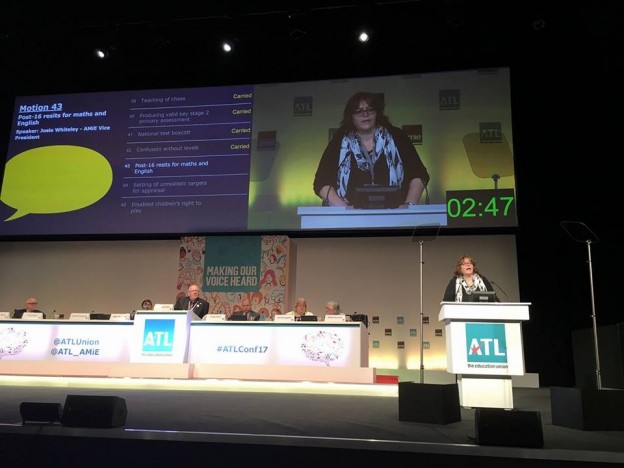
Then came the TUC Congress. I was part of the AMiE delegation and, excitingly, had the opportunity to speak to a motion on post-16 education which is where I have spent my 20-year education career.

I joined the profession after switching from a career in journalism and quickly discovered what an all-consuming job teaching is. I absolutely loved it and threw myself into it wholeheartedly. Over the years I moved on from teaching HE in an FE college to focussing mainly on FE teaching on vocational courses.

I worked my way up, becoming head of department and head of a larger department when two merged. It was at this point I became an AMiE rep –  then I became head of an even larger department following a further merger. This meant I eventually reached the heady heights of the college’s Director of Arts with about 1300 students.

The mergers were really the start of the significant cuts being made to FE funding over the last decade and as I was required to deliver “more for less” and then “even more for even less” my natural sense of justice kicked in and I asked “Why”? I accepted at first that some areas could be run more efficiently without a damaging impact on staff and students. However, FE Colleges have now been operating for some years in a way which has a negative impact on both students and staff, their workload, their results and their health and wellbeing.

Schools are now being hit by funding cuts and the National Funding Formula announced by Justine Greening last week is very disappointing.  There is no new money for schools, which means most will have less money per pupil in 2020 than in 2015.

As a Vice-Chair of Governors in a poorly-funded secondary school I have a close interest in school funding and I am extremely happy the school cuts website started to mobilise action against further cuts as parents realised the implications for their children.

Inadequate funding is at the heart of the National Education Union’s campaigning, and we have been out in force at the TUC Congress and this month’s party conferences, running fringe sessions on funding.

Constant curriculum changes and testing regimes lead to an increasing workload, which in turn exacerbates the staff recruitment and retention crisis which is why the National Education Union will also be campaigning to cut workload. When the Department for Education’s own workload survey shows that leaders are working an average 60-hour week, it’s clear we must tackle this.

Leaders have a significant role to play in defending our education system from an onslaught of dogma-driven changes. We have to challenge the Government when we can see the damage underfunding and debilitating workloads have on our staff and students. Just passing the stress further down the chain of command is not quality leadership and is never going to solve the flaws in the system.

So, Leaders need to be brave, to stand up and be counted. I’ll be blogging and tweeting regularly, so please do join the debate.

@JosieW_AMiE